
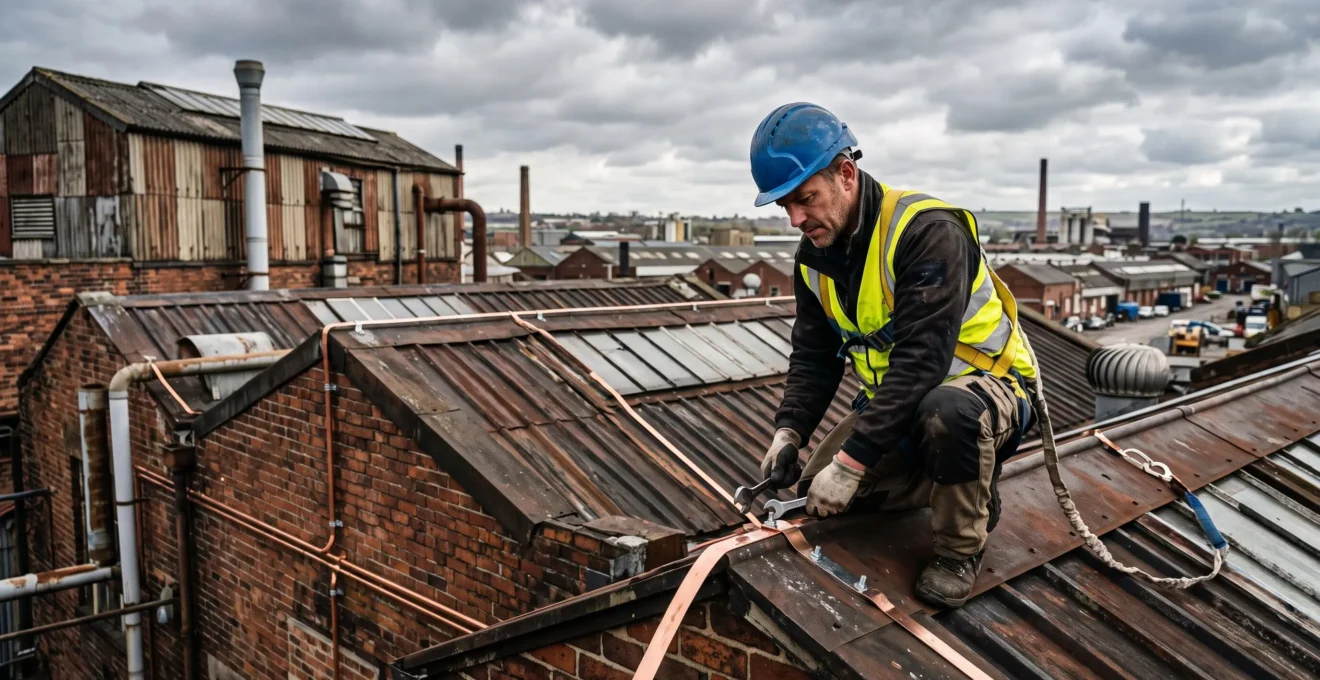
On a 1970s industrial site, the lightning conductor on the roof has been there for decades. The building has been extended, re-roofed and rewired since it was installed — yet nobody has reassessed it, and the insurer now wants proof of compliance before the next audit. That gap between an ageing installation and current standards is exactly where retrofit projects begin.
Direct answer: Lightning protection can be retrofitted on an older industrial building that stays operational, provided the process starts with a risk assessment to IEC 62793 — not with the existing equipment. The assessment determines the required protection level; the system is then designed, installed and documented to BS EN 62305, the British transposition of IEC 62305.
This article follows the sequence a facilities manager can actually present to a board and an insurer: assess the risk with real lightning data, design around the constraints of a legacy structure, plan the works without halting production, and build the compliance file auditors expect. The guiding principle throughout is simple — the lightning data comes first, before any decision about hardware.
- Retrofitting Lightning Protection: What Older Industrial Buildings Actually Need
- How Exposed Is Your Site? Assessing Lightning Risk Before You Build Anything
- Which Retrofit Challenges Do Legacy Buildings Pose?
- Keeping Operations Running During Installation and Storms
- Compliance, Insurance and Documentation: What Auditors Will Ask For
- Planning Your Retrofit: Next Steps and Key Takeaways
Retrofitting Lightning Protection: What Older Industrial Buildings Actually Need
The most vulnerable buildings to lightning are often the hardest to equip: legacy structures, continuous processes, constrained budgets. Yet the pressure to retrofit rarely comes from inside the site. It comes from insurers and regulators who expect provable compliance, not intentions. For sites classified as hazardous installations, guidance from the Health and Safety Executive on lightning risk states that a lightning strike at a major hazard installation “can be an initiating event for a major accident” — and identifies the BS EN 62305 series as the reference good practice for analysing and controlling that risk.
The normative framework is therefore twofold. IEC 62793 governs the risk assessment: it determines whether protection is needed and at what level. IEC 62305, transposed in the UK as BS EN 62305, governs the lightning protection system (LPS) itself — its design, installation, inspection, maintenance and testing. A retrofit that skips the first step and starts with hardware cannot demonstrate compliance to either standard.
This leads to the most persistent myth on older sites: the existing lightning conductor. An installation designed in the 1970s was sized for a building that no longer exists. Extensions, new rooflines, added plant and modified electrical systems all change the risk profile — and none of them triggered a reassessment. A visual check that “the conductor is still there” says nothing about whether the air termination network still covers the current roof geometry, or whether the earth termination system still meets the resistance expectations of the standard. For a COMAH site or any installation handling hazardous processes, the regulator’s position is proportionate but firm: where a reasonably foreseeable risk remains, protection must be demonstrated against BS EN 62305.
For insurers, lightning protection is increasingly judged by the quality of the risk assessment behind it, not simply by the equipment installed on a building. Industrial sites may need to demonstrate how their exposure has been evaluated, how protection measures have been inspected and how potential risks are being monitored over time. That is why lightning protection for industrial buildings increasingly involves more than physical protection alone: reliable exposure data can provide the evidence needed to support a more accurate and defensible risk assessment. The next section explores how that data fits into the process.
How Exposed Is Your Site? Assessing Lightning Risk Before You Build Anything
The IEC 62793 risk assessment is the entry point of every compliant retrofit. It weighs factors such as the building’s dimensions and construction, the nature of the site and its contents, the consequences of a strike for people and processes, and the local level of lightning activity. Its output is not a vague opinion: it is a required protection level — or a documented justification that no LPS is needed. That single output is what converts a budget conversation from “we think we should” into “the assessment shows”.
- Characterise the site.Record building height, roof geometry, construction materials, the presence of hazardous zones and the location of people working outdoors.
- Gather real lightning data for the location.Use the ground flash density of the actual site — the number of cloud-to-ground strikes per square kilometre per year — rather than a national average that may bear no relation to local exposure.
- Check historical strikes.Lightning archives confirm whether the site or its surroundings have already been hit, which sharpens both the risk calculation and post-storm inspection priorities.
- Calculate the risk.IEC 62793 combines these inputs to determine the protection level required — from LPS I, the most demanding, to LPS IV.
- Document the result.The report becomes the baseline document for the insurer, the design brief for the installer and the justification for the budget.
Ground flash density (Ng) : this parameter, defined within the IEC 62305 and IEC 62793 framework, expresses how many cloud-to-ground flashes reach the ground per square kilometre per year at a given location. It matters because two sites 50 miles apart can face materially different exposure; sizing a system on a generic national figure undermines the entire risk case.
One caveat applies to any strike data. A 2018 study published in the journal Weather by the Royal Meteorological Society, based on the Met Office ATDnet detection network, found that a detection efficiency for cloud-to-ground flashes of 90% means more than 10% of ground strike points go undetected. In practice, lightning archives underestimate the true number of strikes — a reason to treat archive data as a minimum, not a ceiling, when arguing exposure.
This is where specialised lightning data services earn their place in the process. Site-specific ground flash density derived from lightning location networks feeds directly into the IEC 62793 calculation and gives the board a defensible number rather than an assumption. The same datasets later serve a very different purpose: proving, with timestamps, where and when strikes actually occurred.
Which Retrofit Challenges Do Legacy Buildings Pose?
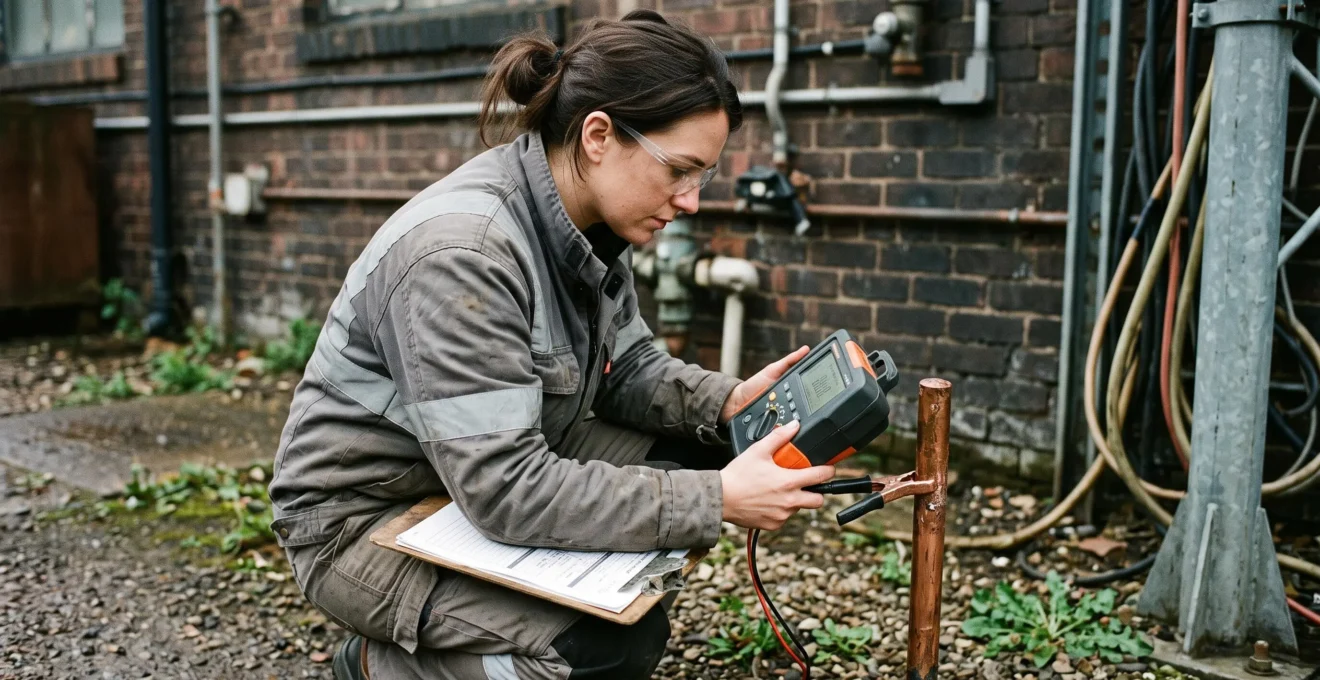
A lightning protection system has three external components — the air termination system on the roof, the down conductors running to ground, and the earth termination system buried below. On a new build, all three are planned before construction. On a legacy site, each one collides with decades of accumulated modifications.
- Fragile or re-roofed surfaces that cannot simply take new fixings or foot traffic.
- Chimneys, stacks and rooftop plant that fall outside the coverage of an original air termination network.
- Steel structures and cladding never intended to carry conductor routings.
- Ground conditions and congestion around the building that complicate a compliant earth termination system.
None of these constraints makes a retrofit impossible. They shape the design. Air termination networks can be adapted to the existing roof using fixings that respect the covering; down conductors can follow discreet routings around process equipment without structural penetrations; earth arrangements can combine existing foundations with new earth electrodes where measured resistance requires it. BS EN 62305 allows installation on existing structures — but it requires the design to demonstrably meet the same performance expectations as a new build, not a relaxed version of them.
The electrical side is often the bigger blind spot. A roof conductor does nothing against the surges that travel into the installation and trip production systems. Internal protection — surge protection devices (SPDs) and equipotential bonding — is what addresses the history of storm-related electrical interruptions. Here too the standard has moved: according to BSI, the 2024 revision of BS EN IEC 62305-4 “gives assurance that retrofitted equipment is sufficiently separated from lightning conductors and lightning bonded equipment”, or that appropriate bonding is achieved where separation is not possible — and that a suitable maintenance cycle is adopted. For a facility manager planning a retrofit, that wording matters: the standard was updated specifically with retrofitted equipment in mind.
An old conductor is not a safe assumption : every modification to the building since the original installation — new rooflines, extensions, added plant, altered electrical systems — can invalidate the original coverage. On a site handling hazardous processes, an unevaluated legacy LPS is not a neutral legacy asset; it is an unverified safety system protecting people and processes. Reassessment is not bureaucracy; it is the condition for trusting the installation at all.
The practical test is straightforward: ask whether the air termination network has been redrawn since the last major building change. If nobody can produce that documentation, the system must be treated as due for reassessment, whatever its apparent condition.
Keeping Operations Running During Installation and Storms
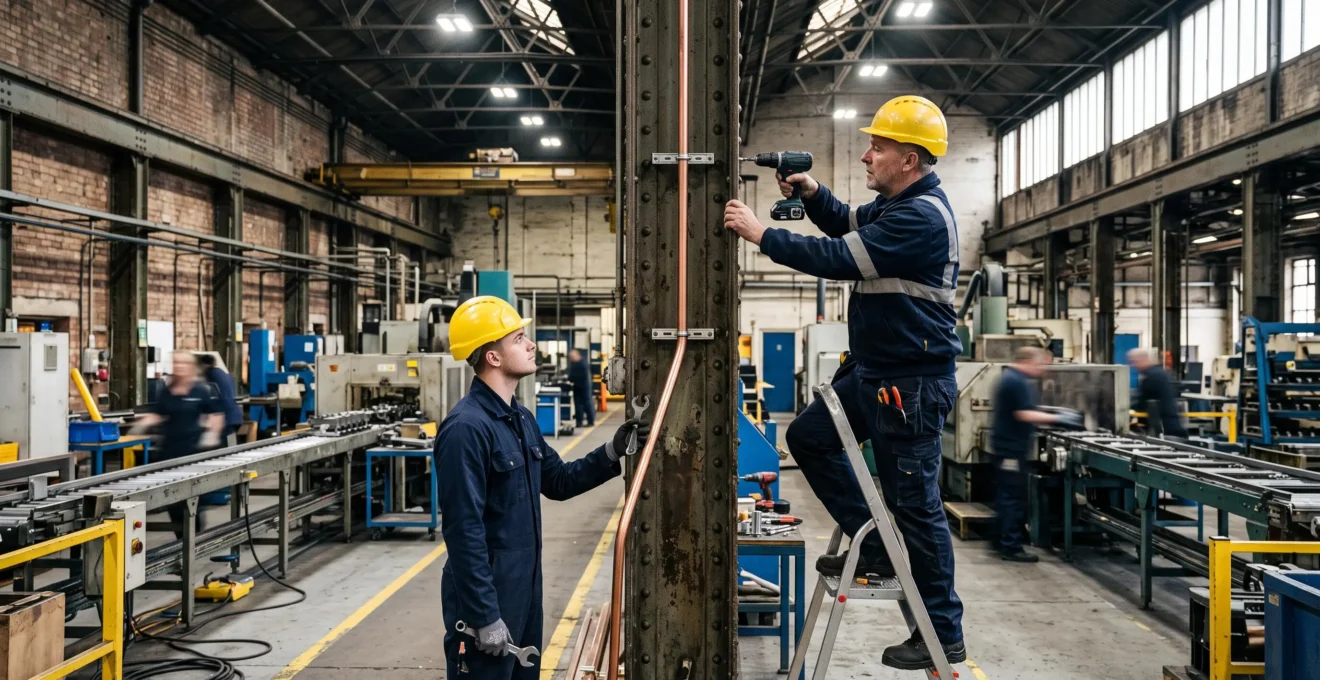
The objection that kills retrofit projects early is operational: production cannot stop so conductors can be fitted. In reality, LPS retrofit work is among the most phaseable industrial works, because most of it happens on the roof, on facades and in the ground — outside the process envelope. The design work happens first, the procurement second, and the physical installation can be split into short windows coordinated around production schedules, maintenance shutdowns and weather.
Three planning practices make the difference on a live site:
- Phase by zone. Treat the retrofit as a sequence of independent work packages — roof sections, down conductor routings, earth works — each with its own access, permit and completion test.
- Agree intervention windows with production. Internal conductor routings near process areas are scheduled into planned pauses rather than imposed on running lines.
- Separate disruptive tasks from continuous ones. Drilling and earth works are noisy and localised but short; conductor fixing is quiet and can proceed alongside normal operation.
Installation is only half the continuity question. The other half is what the site does when a storm is actually overhead — before the retrofit is complete and after it is in service. The operational sequence is now well established on high-risk sites: a thunderstorm warning system detects the approach of lightning in real time; outdoor teams are called back; sensitive processes switch to standby power; and work resumes only once the end of the storm is confirmed. Real-time storm alerts from a lightning location service are used precisely to trigger that sequence — and the same alerts protect the retrofit work itself, since a temporary conductor installation is not a finished one. Nobody should be on a roof when the warning threshold is crossed.
Continuity also has a cost dimension, and it is the argument that lands with a board. Every hour of storm-related downtime avoided is a direct saving, and the pattern compounds across seasons. The logic mirrors other operational disciplines: controlling inventory management to optimize costs rests on measuring flows rather than reacting to shortages — lightning resilience rests on measuring exposure rather than reacting to outages. In both cases, the investment is justified by data, not by the memory of the last incident.
- Alert received — storm approaching :Stop rooftop and outdoor work, call back external teams, confirm standby power is ready, secure sensitive processes.
- Storm overhead :No outdoor work, no roof access; switch critical processes to standby supply; keep personnel in protected areas until the storm has passed.
- End of storm confirmed :Resume outdoor operations only after the all-clear, then run a targeted post-storm inspection of the LPS before returning to normal routines.
One caution on scale: the value of a real-time alerting service depends on the site’s genuine exposure. A measured ground flash density from a lightning location service tells the facilities team how often alerts will actually fire and how to calibrate the protocol — which prevents both complacency and alert fatigue.
Compliance, Insurance and Documentation: What Auditors Will Ask For
The retrofit is only finished when the file exists. For sites under the COMAH regime, HSE guidance treats lightning as a potential initiating event for a major accident and expects protection concepts — bonding, earthing, LPS — designed and maintained against BS EN 62305. Insurers auditing such sites ask for the same chain of evidence, and the pattern is consistent: they want documents that prove the risk was assessed, the system was installed to standard, and it has been maintained since.
- Risk assessment report.The IEC 62793 assessment, with the site-specific lightning data used, concluding on the required protection level.
- Design documentation.LPS drawings showing air termination coverage, down conductor routings and earth termination arrangements against BS EN 62305.
- Installation and inspection certificates.Records of commissioning tests and inspections, signed by competent persons.
- Maintenance and test register.Periodic earth resistance and continuity tests, with dates and results — the part most often missing on legacy sites.
- Storm and incident records.Post-storm inspection reports and dated strike data covering any event that caused damage.
The last item deserves its own attention, because it is where many claims stall. When a storm trips a process or damages equipment, the insurer asks one question: can the site prove a strike actually occurred, where, and when? Timestamped lightning location data from services such as METEORAGE provides exactly that evidence — a dated, located record of strikes that, combined with a post-storm inspection report and the maintenance register, turns an allegation into a documented claim.
On the regulatory timeline, the logic is not new. Risk-based lightning assessment for classified hazardous sites was made mandatory in France by a 2011 decree under the ICPE framework, and the same risk-assessment principle was subsequently generalised across Europe through the IEC framework, transposed in the UK as BS EN 62305. The direction of travel has been consistent for over a decade: from “a conductor exists” to “the risk is assessed, the system conforms, the evidence is documented”.
Case study
Consider the case of a facilities manager at a 1970s chemical plant facing an insurer’s audit. Rather than commissioning new hardware first, the site runs an IEC 62793 assessment using local strike archives, discovers the legacy conductor no longer covers an extension built years earlier, and presents the board with a phased retrofit plan — assessment report, design, installation windows, test records. When the next storm trips a production line, the combination of timestamped strike data and a post-storm inspection gives the insurer a complete, dated evidence chain.
Planning Your Retrofit: Next Steps and Key Takeaways
The order of operations is what makes a retrofit defensible. A plan built in this sequence can be presented to a board as a budget case and to an insurer as a compliance case, because each step produces the document the next one relies on.
- Start with an IEC 62793 risk assessment using the site’s real ground flash density — not with the existing equipment.
- Treat a legacy lightning conductor as due for reassessment after any building modification.
- Design to BS EN 62305 around the constraints of the existing structure, including surge protection and bonding.
- Phase the installation into short windows so production keeps running, and use real-time storm alerts to protect both teams and output.
- Close the project with a documented compliance file: risk report, certificates, test register, post-storm records.
For a facility manager under audit pressure, the realistic first move costs little and unlocks everything: commission the risk assessment and the strike-data review. Those two items produce the evidence that justifies the rest of the programme, and they turn the next storm from a threat into a test of a documented system. Preparing that case also means articulating why the site exists and what it protects — a discipline that extends beyond safety, as explored in guide for writing your corporate purpose.
This article provides general information on retrofitting lightning protection to BS EN 62305 and IEC 62793. It does not replace a site-specific risk assessment, a competent LPS designer’s design, or advice from your insurer. Requirements for COMAH and other high-hazard sites depend on the individual installation and should be confirmed with the regulator and your insurer.